Confusion Matrix
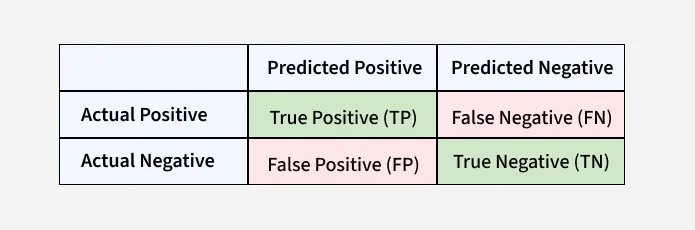
A confusion matrix puts into perspective how well the classification model did. For binary classifcation, we can think of it like this: - True Positive (TP) — the number of times the model predicted a "positive" outcome and the outcome was "positive" - True Negative (TN) — the number of times the model predicted a "negative" outcome and the outcome was "negative" - False Positive (FP) — the number of times the model predicted a "positive" outcome when it was supposed to be "negative." For stats people - this is a Type 1 Error. - False Negative (FN) - the number of times the model predicted a "negative" outcome when it was supposed to be "positive." For stats people - this is a Type 2 Error.
Accuracy = TP + TN / (TP + TN + FP + FN)
Precision = TP / (TP + FP)
Recall = TP / (TP + FN)
F1 Score = (2 * Precision * Recall) / (Precision + Recall)
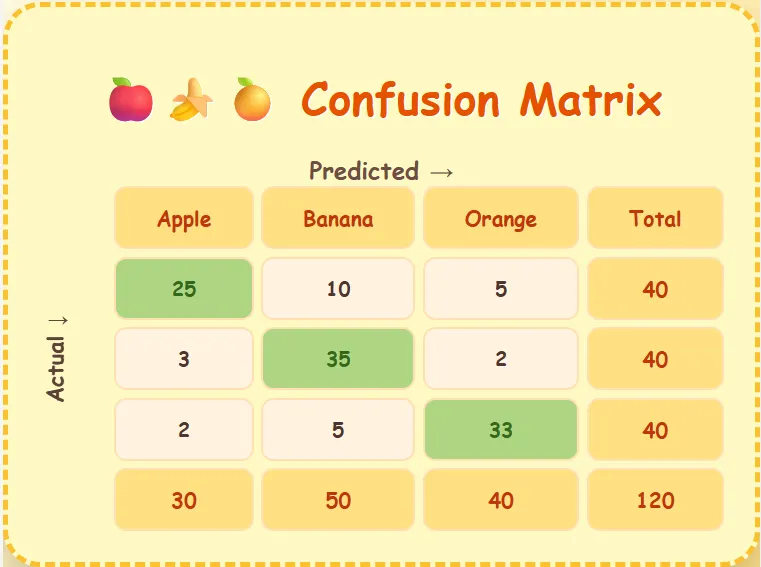
A matrix can also be used for classification models with multiple classes. The medium article "Confusion Matrix for Multi-Class Classification" by SadafKauser depicts a matrix used for a model that will depict fruit.